Overview
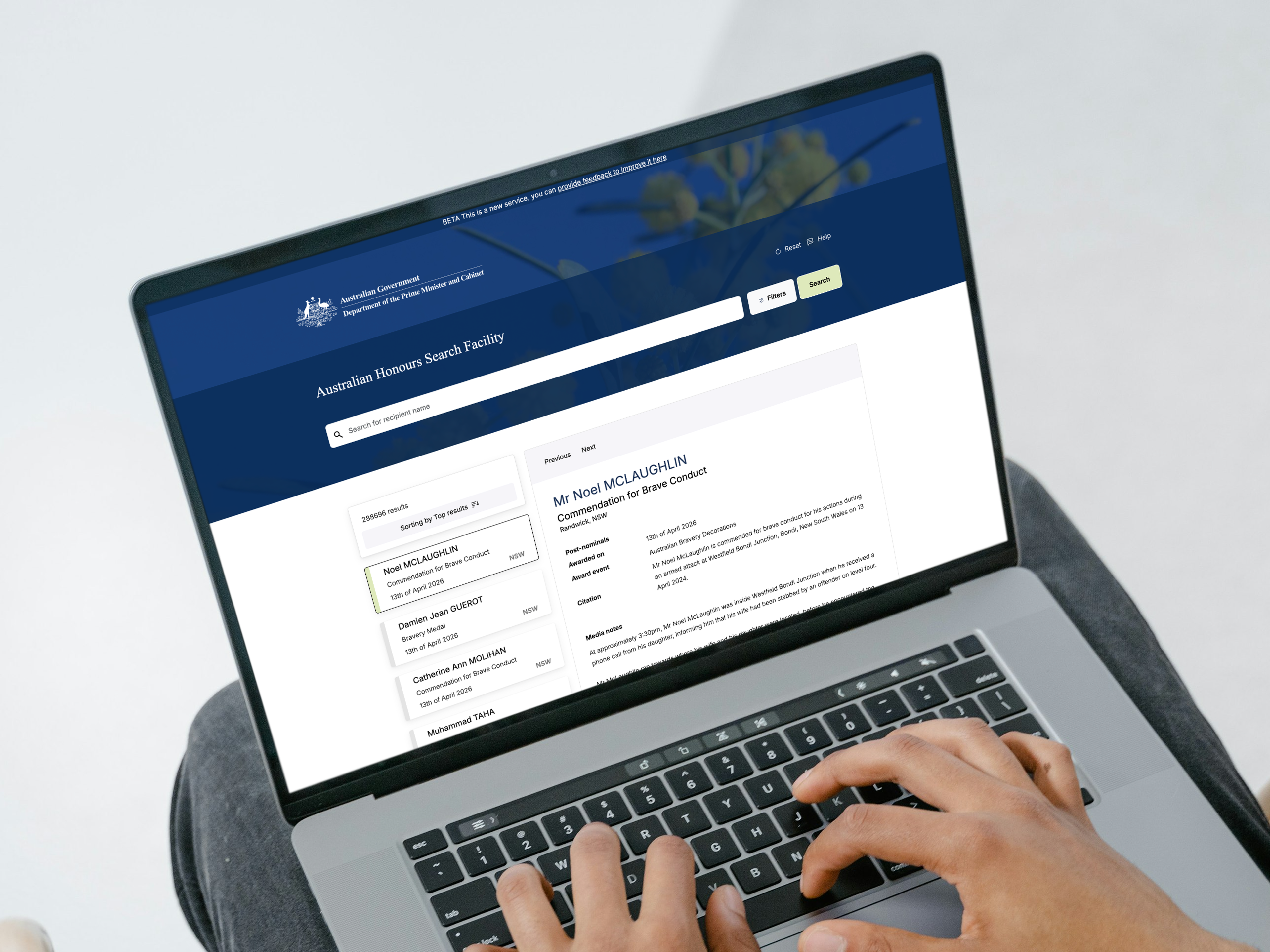
As a UX Designer working with PM&C, I led the UX redesign of the Australian Honours Search experience, a government platform allowing users to search and explore recipients of Australian honours and awards. Working within a small team, I recruited participants through Askable to ensure design decisions were grounded in real user behaviour. My role spanned usability testing, interaction design, and iterative development from low fidelity concepts through to high fidelity designs.
Problem Statement
The existing Honours Search experience had usability and clarity challenges that made it difficult for users to effectively find and interpret information about award recipients.
Key challenges included:
- Search interactions that were not intuitive, impacting discoverability of relevant records
- Inconsistent structure and presentation of results making it harder to scan and compare entries
- Gaps in interface hierarchy reducing clarity when navigating between search and detailed views
- Limited design consistency across UI patterns creating friction throughout the experience
Deliverables
- Usability testing sessions with recruited participants via Askable to validate search behaviour and identify pain points
- Desktop research to understand comparable search and data exploration patterns
- Early design system direction to improve consistency across search and results components
- Low fidelity wireframes to explore layout and interaction approaches
- Mid fidelity prototypes to refine structure and usability of key flows
- High fidelity UI designs ready for validation and development handover
- Iterative design improvements based on user feedback across multiple testing rounds
Outcome
The redesign improved the clarity and usability of the Honours Search experience, making search interactions more intuitive and results easier to scan and interpret. A more consistent UI structure helped users navigate between search results and detailed records with greater ease. Iterative testing ensured design decisions were grounded in real user behaviour, and early design system thinking set a stronger foundation for future platform enhancements.